Oxygen depletion in a fixed volume due to inert gas leak with constant recycle
The following is an extension of the work on this page for a system where nitrogen leakage into a room results in oxygen depletion—this only considered that the HVAC inlet was 100% pure air.
For a system with an HVAC outlet recycle stream, the following expression gives the required nitrogen flow rate
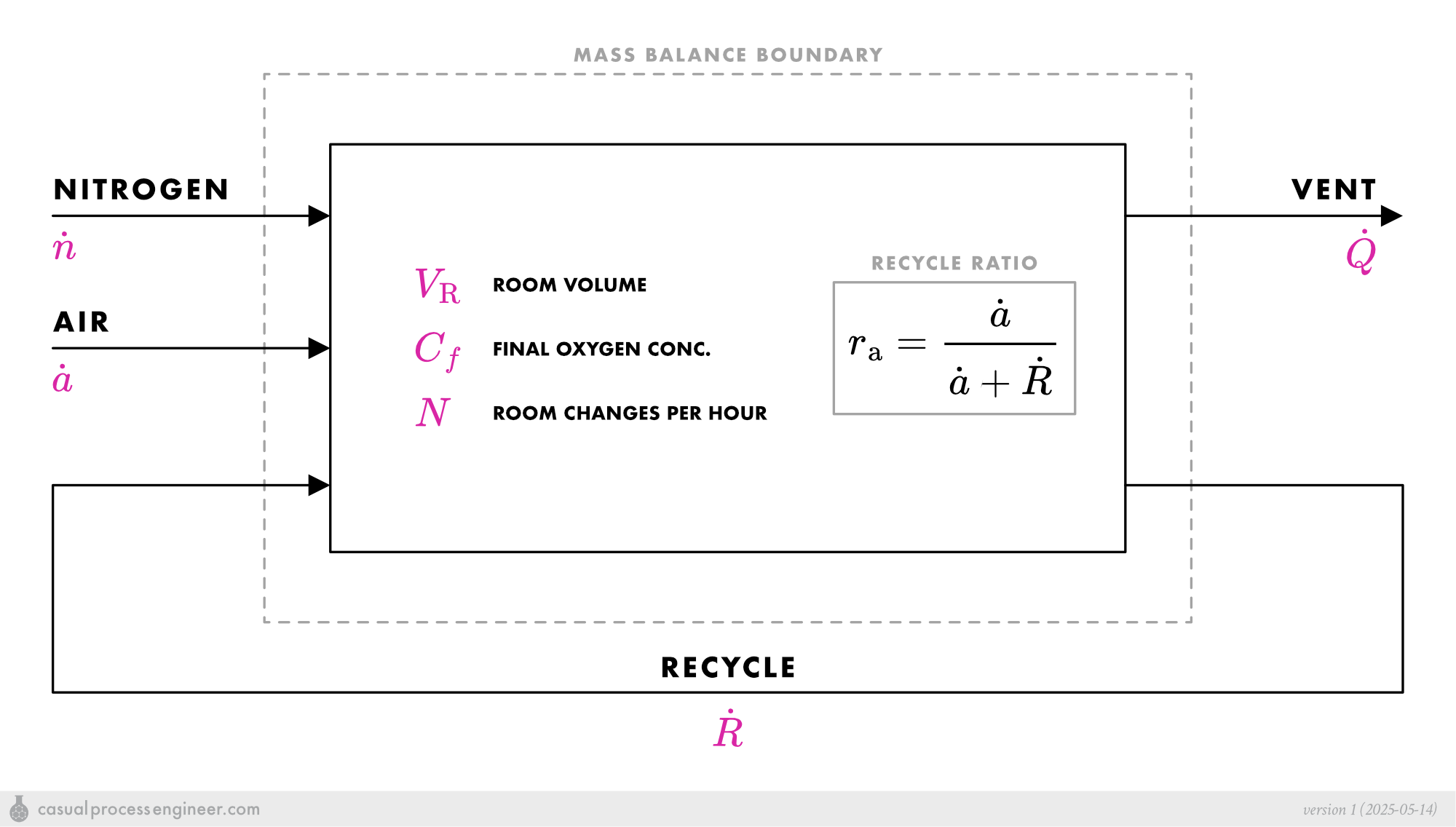
| Symbol | Description | Units |
|---|---|---|
| Volumetric flow rate of air (contains 21% O₂) | m³/h | |
| Volumetric flow rate of pure nitrogen (contains 0% O₂) | m³/h | |
| Vent flow rate from the room | m³/h | |
| Recycle flow rate (taken from and returned to the room) | m³/h | |
| Volume of the room | m³ | |
| Number of air changes per hour | h⁻¹ | |
| Final steady-state oxygen concentration in the room (volume fraction) | — | |
| Fraction of air in the combined air + recycle stream: | — |
Derivation
Determine the nitrogen flow rate
Assumptions
- Assumes instantaneous perfect mixing. Whilst concentration will average out to some degree in large spaces, this method does not account for local oxygen depletion. This will be significant at the point of release.
- All flowrates given in
at atmospheric pressure. - Air into the system via HVAC unit is a constant volumetric flow and taken as 21 vol% oxygen.
In a system where a proportion of the room air is recycled, we define the ratio of pure air in the total inlet stream (air + recycle):
Assuming all gases are at room temperature and pressure we can do a volumetric flow balance:
The oxygen entering and leaving the system must also be balanced. Using the system boundary that includes both vent and recycle:
Cancelling
Room changes now consider both vent and recycle flows:
From
Substitute
From
Substitute
Rearrange
From
Substitute