Heat loss from a pipe
The total heat loss from a pipe is given by:
where
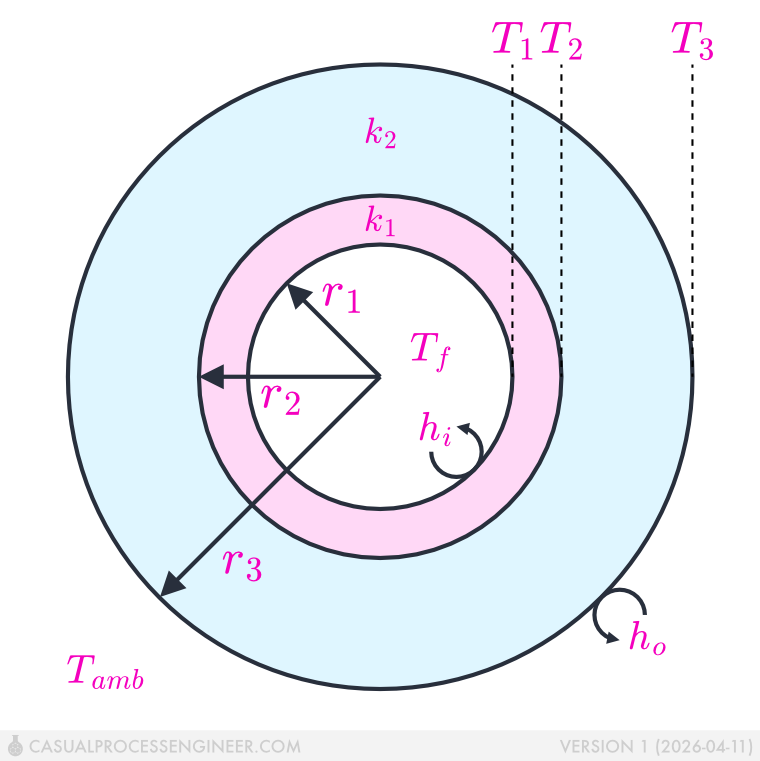
This assumes steady-state, one-dimensional radial heat transfer with resistances acting in series. The model covers three physical mechanisms: conduction through the pipe wall and insulation, convection at the inner and outer surfaces, and radiation from the outer insulation surface to the surroundings.
Iterative solution required
The radiative coefficient
depends on the outer insulation surface temperature , which is itself an output of the calculation. The resistance network must therefore be solved iteratively: assume , compute , solve for , back-calculate from the outer resistance, and repeat until convergence.
Nomenclature
| Symbol | Description | Units |
|---|---|---|
| Total heat loss rate | W | |
| Bulk fluid temperature (inside pipe) | K | |
| Ambient temperature (surroundings) | K | |
| Inner pipe wall temperature | K | |
| Outer pipe wall temperature (pipe–insulation interface) | K | |
| Outer insulation surface temperature | K | |
| Inner convective heat transfer coefficient | W/m²·K | |
| Outer convective heat transfer coefficient | W/m²·K | |
| Radiative heat transfer coefficient | W/m²·K | |
| Inner pipe surface area, | m² | |
| Outer insulation surface area, | m² | |
| Inner pipe radius | m | |
| Outer pipe radius (pipe–insulation interface) | m | |
| Outer insulation radius | m | |
| Thermal conductivity of pipe wall | W/m·K | |
| Thermal conductivity of insulation | W/m·K | |
| Pipe length | m | |
| Emissivity of insulation outer surface | — | |
| Stefan–Boltzmann constant, | W/m²·K⁴ | |
| Inner convective resistance | K/W | |
| Pipe wall conduction resistance | K/W | |
| Insulation conduction resistance | K/W | |
| Outer combined (convection + radiation) resistance | K/W |
Mechanisms
Conduction
In a solid, the flow of heat by conduction is the result of the transfer of vibrational energy from one molecule to another, and in fluids it occurs in addition as a result of the transfer of kinetic energy. Heat transfer by conduction may also arise from the movement of free electrons, a process which is particularly important with metals and accounts for their high thermal conductivities.
— Coulson and Richardson, Vol. 1
Conduction through plane walls
The rate of heat flow
INFO
The negative sign indicates that heat flows in the direction of decreasing temperature. Integrating over a finite thickness
, where varies linearly with temperature:
where
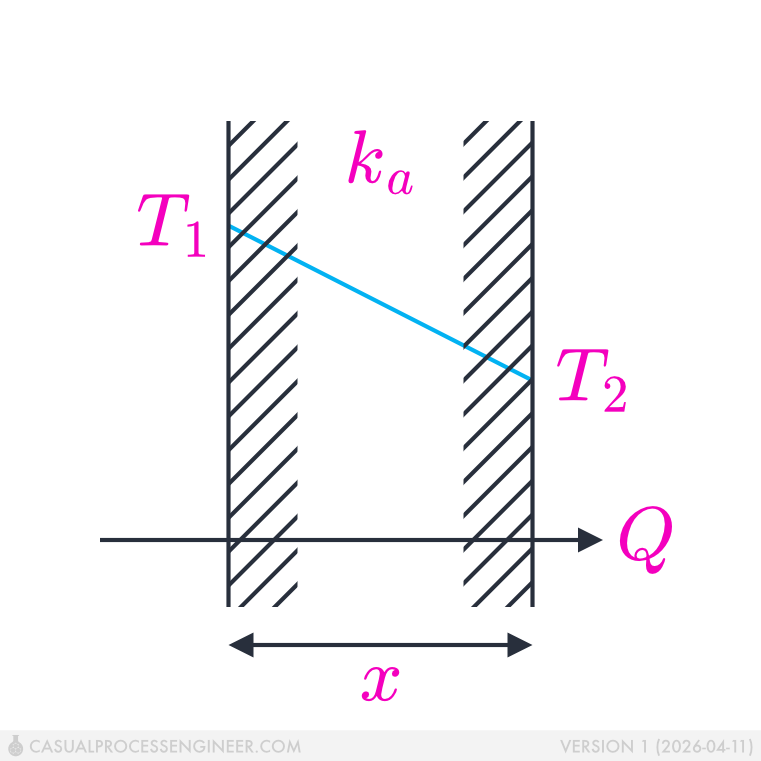
The ratio
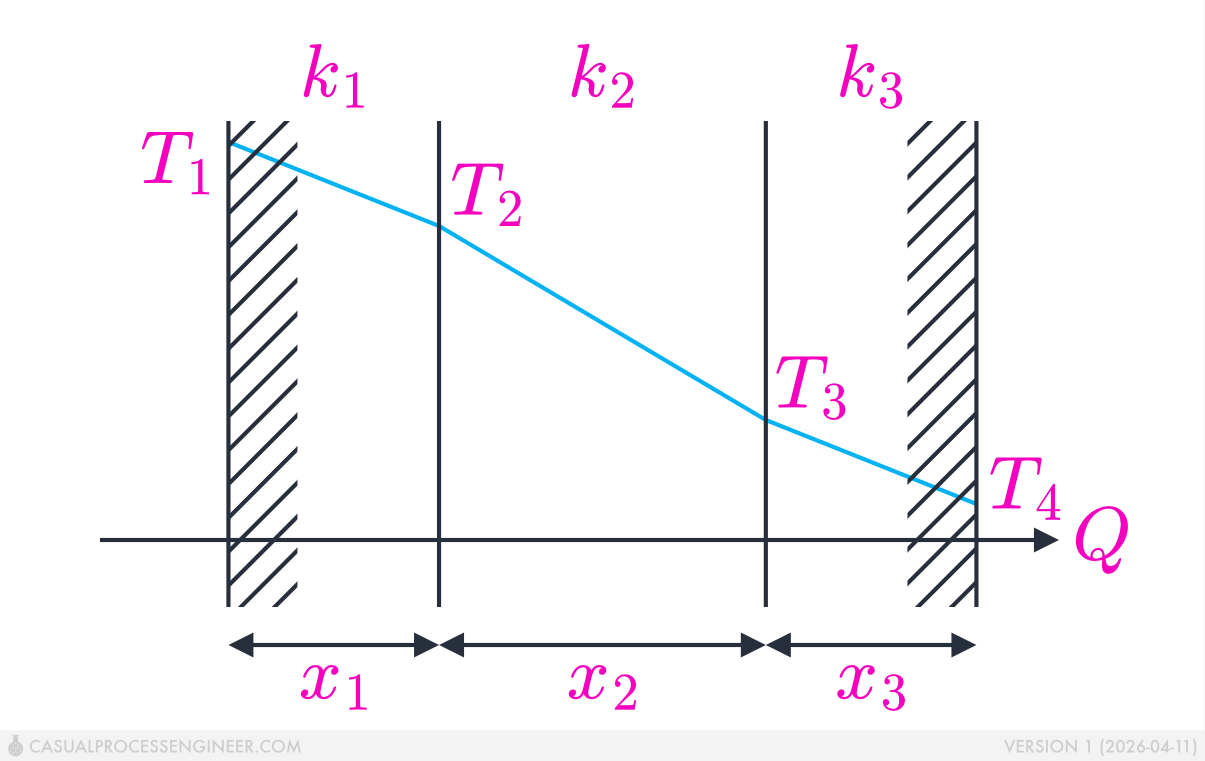
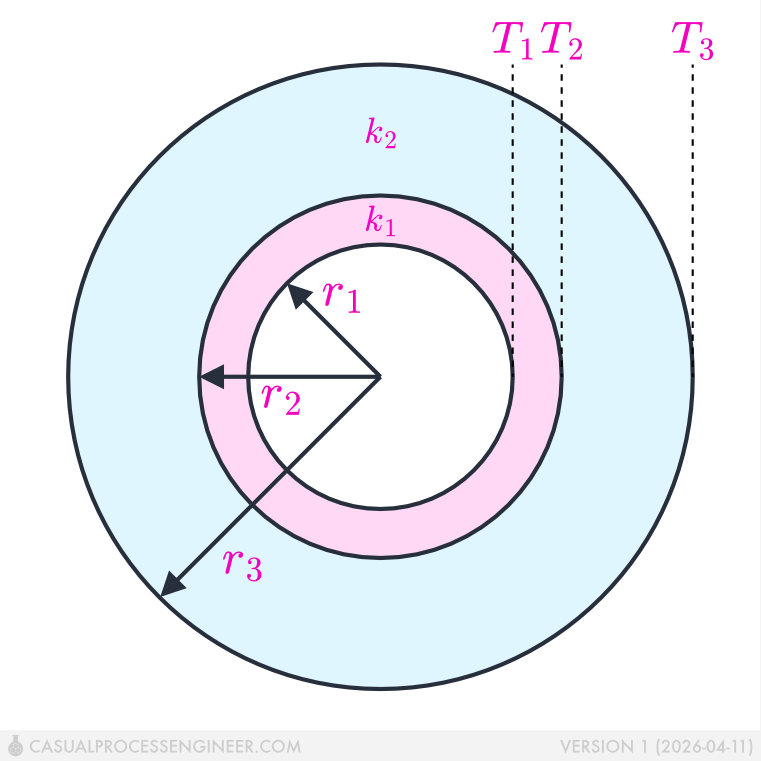
Conduction through a tube wall
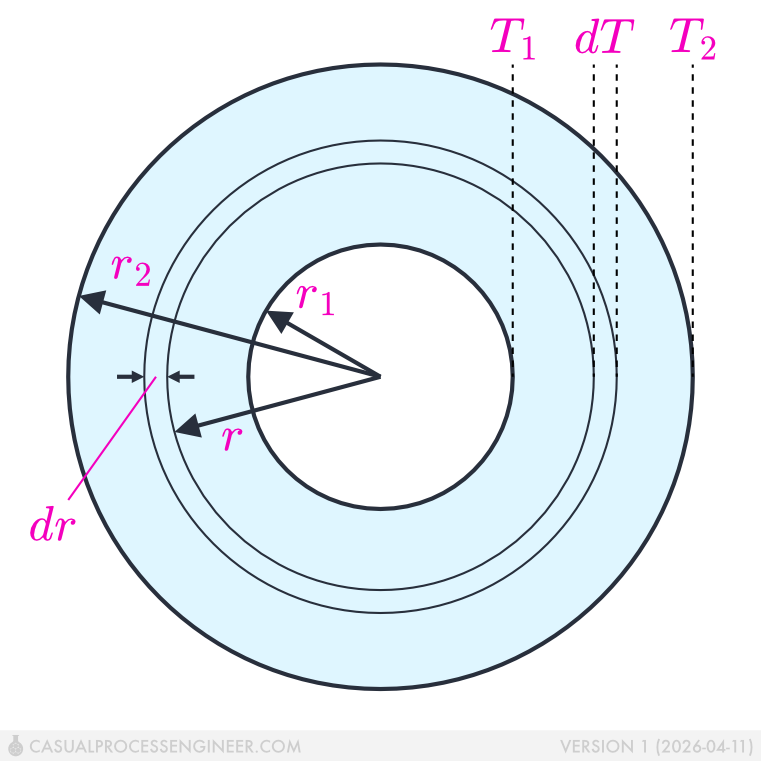
For a cylindrical geometry, the heat flux is proportional to the local surface area, which increases with radius. The temperature gradient is therefore inversely proportional to radius. At any radius
Separating variables and integrating between
For multiple layers (e.g. over a pipe wall and insulation):
Convection
Heat transfer by convection arises from the mixing of elements of fluid. If this mixing occurs as a result of density differences — as, for example, when a pool of liquid is heated from below — the process is known as natural convection. If the mixing results from eddy movement in the fluid, for example when a fluid flows through a pipe heated on the outside, it is called forced convection. It is important to note that convection requires mixing of fluid elements, and is not governed by temperature difference alone as is the case in conduction and radiation.
— Coulson and Richardson, Vol. 1
When a fluid is in contact with a surface at a different temperature, heat is transferred by convection. The rate of heat transfer is described by Newton’s law of cooling:
where
Inner convection — fluid to pipe inner wall
where
Outer convection — insulation surface to ambient air
where
The outer convective coefficient
The Grashof number quantifies the ratio of buoyancy to viscous forces:
where
An empirical correlation maps
where
Radiation
All materials radiate thermal energy in the form of electromagnetic waves. When this radiation falls on a second body it may be partially reflected, transmitted, or absorbed. It is only the fraction that is absorbed that appears as heat in the body.
— Coulson and Richardson, Vol. 1
Radiation from the outer insulation surface to the surroundings is given by the Stefan–Boltzmann law:
where
This expression is appropriate for a pipe radiating to an open environment but should be reconsidered if the pipe is in a confined or high-temperature enclosure.
Linearised radiative coefficient
To incorporate radiation into the resistance network, equation (12) is linearised so the radiative heat flux can be written in the form
Reference
Ref equation (5-12) in Perry’s Chemical Engineers Handbook
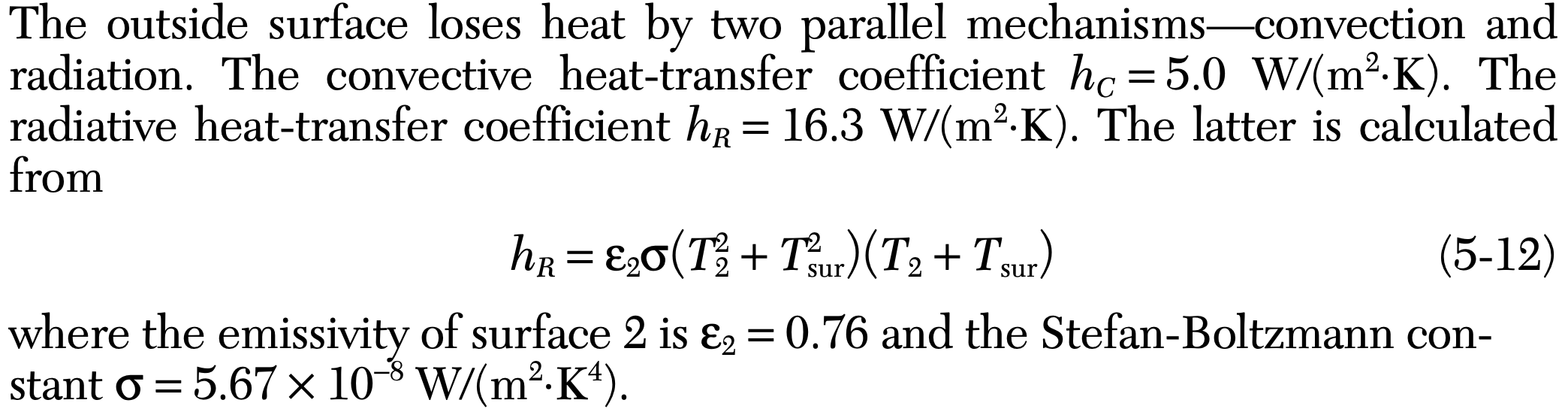
The total outer heat transfer (convection and radiation in parallel, sharing the same surface area and the same driving temperature
which yields the outer thermal resistance:
The parallel addition of
Since