Flash calculations
Flash calculations are used to determine the equilibrium distribution of components between the vapour and liquid phases when a multi-component mixture undergoes a phase change, such as in distillation, evaporation, or condensation processes. The calculations involve combining equations for Vapour Liquid Equilibrium (VLE) with the component mass balances, and in some cases the energy balance.
WARNING
The calculations below primarily assume that VLE is based on Raoult’s Law for ideal mixtures which states that the vapour pressure of each component is proportional to its mole fraction in the liquid phase.
The K-value for a component
Nomenclature
| Symbol | Description | Unit |
|---|---|---|
| Mole fraction of component | ||
| Mole fraction of component | ||
| Mole fraction of component | ||
| Raoult’s Law K-value or Equilibrium Constant for component | - | |
| Total pressure of the system | ||
| Partial pressure of component | ||
| Vapour pressure of component | ||
| F | Total molar feed flow to flash vessel | |
| V | Molar vapour flow from flash vessel | |
| L | Molar liquid flow from flash vessel | |
| Feed stream molar enthalpy | ||
| Vapour stream molar enthalpy | ||
| Liquid stream molar enthalpy |
Bubble point calculation
To find the point at which liquid just starts to boil at a given temperature we compute where the sum of the vapour fractions reaches 1.
Where Raoult’s Law applies this gives:
The vapour composition of each component can then be calculated:
Dew point calculation
To find the point at which vapour just starts to condense at a given temperature we compute where the sum of the liquid fractions reaches 1.
Where Raoult’s Law (substitute
NOTE
When calculating dew point with non-condensable component
far above its critical point we can assume , and so goes to zero.
Flash to determine liquid and vapour streams
Flash on a stream that splits to a vapour and liquid stream.
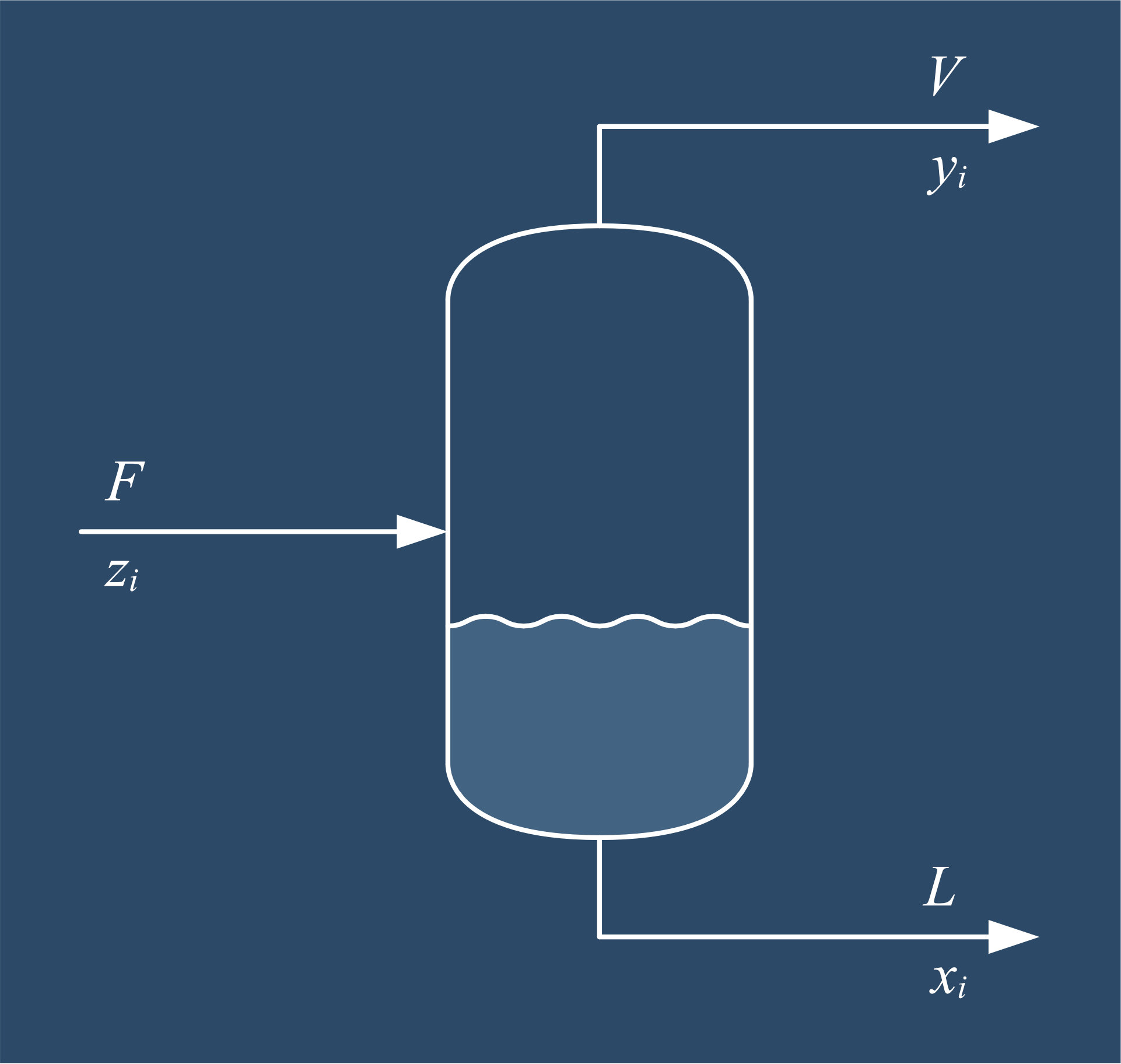
The initial material balance on component
We add a further specification by assuming that the vapour and liquid are at equilibrium and follow Raoult’s Law:
Pressure-Temperature flash
By substituting equation
Substituting total molar balance
The vapour split
which is easy enough to solve for the vapour split
Pressure-Enthalpy flash
For an adiabatic flash we must consider the energy balance of the system by maintaining a constant enthalpy:
Approach as per Pressure-Temperature flash above and iterate on