Flow in partially full pipes
The Manning formula is often used to determine flow in partially full pipes however more modern practice is to use methods analogous to those used for full pipes under pressure flow based on the Darcy-Weisbach equation and the Colebrook-White equation for friction factor. The use of the Darcy Weisbach equation is further supported by our application (small diameter pipes) rather than large open channels such as rivers and waterways. The computations are made easier by the availability of a number of approximations to the Colebrook-White equation that are not explicit in friction factor.
Inclined pipe capacity
Flowrate
Where:
= volumetric flowrate ( ) = cross sectional flow area ( ) (not the pipe) = slope of the pipe ( )
Hydraulic radius
Where:
= hydraulic radius ( ) = cross sectional pipe area ( ) = wetted perimeter ( )
Reynolds number for open channel flow
Where:
= liquid density ( ) = absolute viscosity ( ) = fluid bulk (average) velocity ( ) = hydraulic radius ( )
Derivation of equation (1)
By Darcy-Weisbach:
Where:
= head loss due to friction (m) = friction factor = pipe length (m) = pipe diameter (m) = fluid bulk (average) velocity (m/s) = acceleration due to gravity ( )
Hydraulic radius is defined as:
Where:
= hydraulic radius ( ) = cross sectional pipe area ( ) = wetted perimeter ( )
So for a full pipe:
Substituting into equation
Substituting the line slope
It should be noted that the equations as presented in ref. 4 include relative roughness and Reynolds number in terms of the hydraulic diameter for full pipes
Where:
= relative roughness = = hydraulic diameter (pipe diameter) (m) = absolute roughness (m) = Reynolds number based on hydraulic diameter for full pipes
Reformulating the Haaland equation in terms of hydraulic radius for part full pipes
Where:
= Reynolds number based on hydraulic radius for part full pipes
Substituting equation (10) into (8):
Flowrate in the pipe
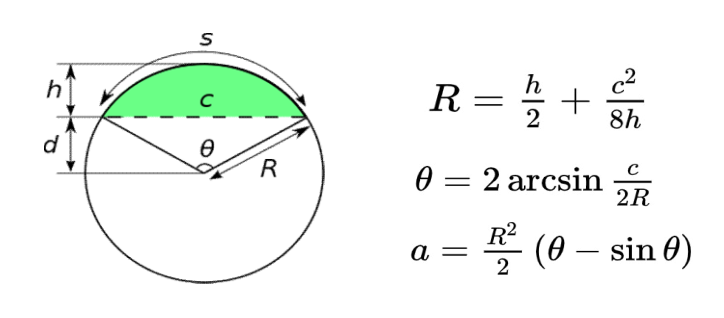
Where a is the green area.
References
- Open Channel Flow Resistance, Yen B C, Journal of Hydraulic Engineering, Jan 2002
- Computer Applications in Hydraulic Engineering, Halsted Methods Inc., 2002
- Water & Wastewater Enginering Hydraulics, Casey T J, Aquaverra Research Ltd, 2004
- A Review of Explicit Approximations of Colebrook’s Equation, Genic et al, FME Transactions (2011) 39, 67-71
- Perrys Chemical Engineers Handbook, 7th Edition
- ASME BPE 2012
- Designing Piping for Gravity Flow, P D Hills, Chemical Engineering, September 1983
- HTFS Handbook, FM8, Design of Gravity Flow Systems
- HTFS Handbook, FP3, Gravity Flow
- Purging & Air Removal, Richard A Beier, Mechanical Engineering Technology Department, Oklahoma State University, 2009
- Air In Pipelines, A Literature Review, HR Wallingford, Report SR 649, April 2005
- Co-current air-water flow in downward sloping pipes, Pothof, Technical University of Delft, 2011
- Simpson L.L. 1968 “Sizing Piping for Process Plants” Chem Eng 75 No. 13 (June 1968) p192
- Not used.
- Air Problems in Pipelines, A Design Manual, HR Wallingford, 2005. ISBN-10 1-898485-11-9
- ANSI / HI 9.8 - 1998, American National Standard for Pump Intake Design